
Declare
Pick from twelve real intents. Hold several at once, because real people do.
Twelve intents. Hold several. Let them expire.
Every network stores your title and your history. None of them store the thing that would actually let someone help you: what you are trying to make happen this month.
So the most useful fact about you is the one nobody can see, and the introductions you get are based on what you were doing two years ago.
An intent is a live statement of what you are trying to do, with the constraints that make it real.
Raise, invest, hire, find a role, land a customer, form a partnership, find a cofounder. Each one carries its stage, sector, geography, ticket size and exclusions.
And an expiry. A stale intent disappears instead of quietly staying searchable, so nobody is matched against something you stopped wanting six months ago — and nobody wastes an introduction on it.
Pick from twelve real intents. Hold several at once, because real people do.
Stage, sector, geography, ticket, exclusions. The things that decide eligibility.
Set how long it is true for. Silence is never read as an ongoing ask.
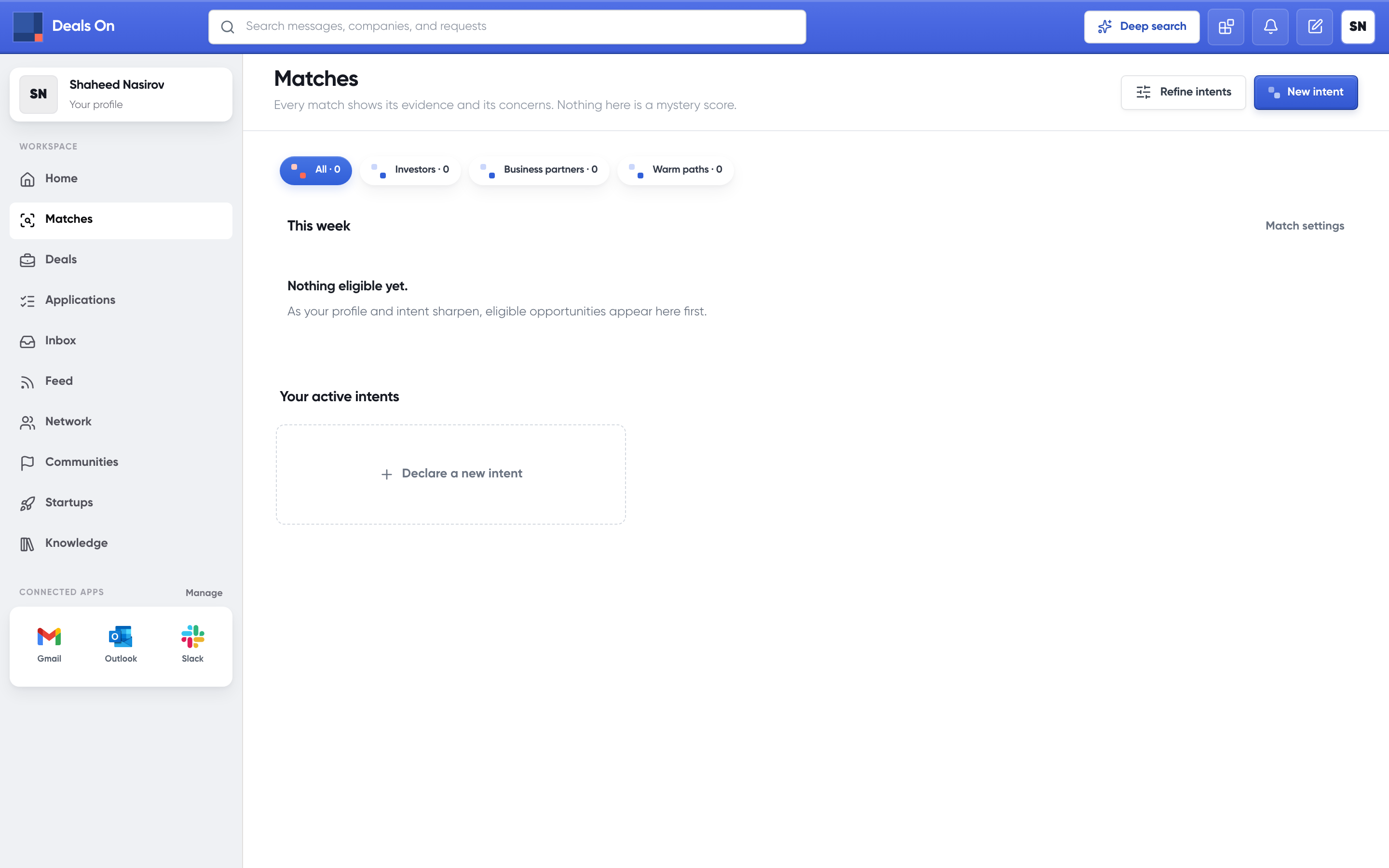
What the declared intent produces
The four decisions behind how this behaves.
A fixed vocabulary is what lets two sides match at all. Free text matches nothing.
Raising and hiring in the same week is normal. One account, several live intents.
They decide eligibility before anything is ranked, so ineligible matches never appear.
The alternative is a graph slowly filling with things nobody wants any more.
Declaring an intent is a deliberate act, and switching it off removes it from matching entirely — not from the display while the engine keeps using it.
Which is everyone. The title on your profile is a year behind what you need this month.